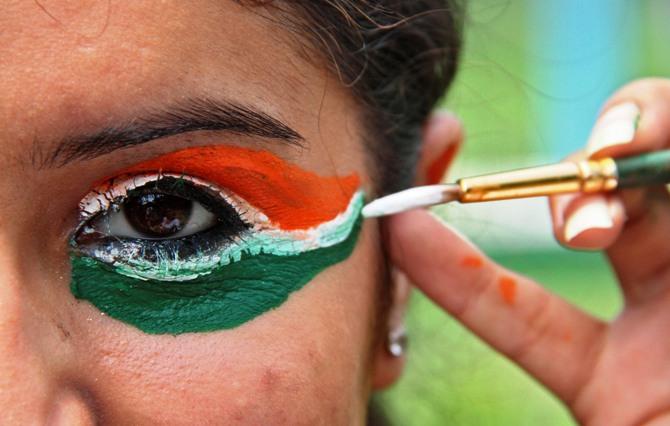
“India First” is a relevant idea in the present scenario of 21st century, where India is not only a secluded concept, but rather a global one. Since 1991, when our economy opened up and assumed more global dimensions, as we graduated towards a free market society, the relevant social question of sacrificing our national interests for materialistic concerns has found a place in skeptical minds. As a direct fallout of the change, traditionally a culturally sensitive nation, India today faces the challenge of obliteration of its very concept. In this present age of capitalism, of rat-race for profit and individual needs, the question of whether India would survive bears significant proportion. Equally, in the bureaucratic framework, the problem of corruption lingers, which is the worst example of fulfilling individual aspirations at the stake of interest of our nation, where people still hardly manage two square meals a day! In this scenario, it is imperative that we address these concerns as soon as possible, so that India, as an entity can express itself independently to the changing world. This can only be achieved if people put aside their own aspirations that come in the way of the collective prosperity and growth of the country.
India has been a source of inspiration to the rest of the world, since time immemorial. Civilization in India dates back to 1700 B.C, the Indus valley civilization, when most people of the world were still nomads. Indians of that time had knowledge of urban planning, sanitation system, engineered metallurgy, and lived as a peaceful egalitarian society. Thus the Indus valley civilization left behind a legacy of knowledge and an era of arts, science, engineering and peaceful co-existence which manifested in culturally rich inventions. The digit zero and the numbering system, the decimal system, algebra, trigonometry and calculus, chess, the game of snakes and ladders, the value of “pi” are only a few in the count. Charaka, the father of medicine, practised medicine 2500 years ago. Ayurveda is the earliest literature of medicine known to mankind. The Aryans, the Guptas and the Mauryas left behind a culturally rich nation of non-violence and penchant for music, architecture, sculptures and painting superfluous with wealth, trade with foreign countries and overall a happy life. Due to its wealth, India has attracted foreigners, through her history. Persian invasion in 500 BC showed the way which was followed by the Greeks, the Turks, the Mughals, the Portuguese, the Dutch , the French and finally the English, who ruled for around 200 years. India, during these periods, was mostly ruled by selfish kingdoms under rival chiefs and rulers. Never united as they were, intruders took the best advantage of the situation and continued to plunder her wealth. Indians remained dumb and blind to these external aggressions. The freedom movement paved the way for building a united nation out of India. However, differences still exist amongst ourselves, we still prioritize region and language over the nation which has led to the continual fragmentation of the nation. Demand for more states keep arising time and again, from all corners of the country. Until and unless we imbibe the spirit of “being Indian” and put the nation ahead of all such differences, India will surely revert to its old self, a mere cluster of small states fighting against each other. Such social divisions made by ourselves need to be abolished. Or it won’t take long for another British Empire to crack us down. In such a situation, what more can we expect, except that we will be plunged in everlasting slavery.
Since our independence in 1947, we have seen a shift in India’s population patterns. The post-independence industrialization of various cities led to the migration of people of various linguistic groups from relatively rural areas. This led to conflicts between various groups for reasons ranging from accommodation to cultural xenophobia. The regionalist identities were given preference over the fact that they were after all, Indians. Mention may be made of Mumbai, then Bombay, where in the post-British era, speedy industrialization led to the influx of people from rural Maharashtra, the South and places like Uttar Pradesh and Bihar. This unprecedented inflow led to the problem of accommodation, and this gradually took the shape of one of the worst linguistic conflicts in this country. The reason was simple, people were exerting their linguistic authority, in a country where the Constitution has provided rights for Indians to settle anywhere across the State. On similar lines, communal riots have occurred regularly since Independence. The post-partition riots, anti-Sikh riots, post-Babri riots, and riots in Gujarat have been a blot on our collective conscience. What we cannot envisage is the communal disharmony and religious discrimination that infiltrates into the society defying all norms of humanity. Religious fanaticism receiving priority over Indian identity have created these indelible blemishes on our history. This is in direct confrontation with the secular ideals of the Constitution, where we have pledged to profess ideals of Justice, Liberty, Equality and Fraternity. It seems that these words have been confined to the pages of the Constitution, and have not been reflected in the hearts and minds of people. Until and unless we put India first over our alignment to petty interests, we will continue to tarnish the image of such a glorious and prospective civilization in front of the world to who we present ourselves as a nation where “Unity in Diversity” exists.
The problems of a caste-based feudal framework that crept into the Indian social structure that existed since earlier times, and which assumed more dangerous proportions in the medieval ages, has also left our society fractured. This mindset is still prevalent in all Indian states, specially the states like Uttar Pradesh, Bihar etc., and even states like Tamil Nadu in the South. Reservation for lower castes is one issue, where politicians have made every effort to pursue their own filthy political interests rather than trying to solve the issue. This age-old mindset has to be done away with, if we desire to put Indian first, and fit the credentials of being the largest democracy in the world. People in India still vote putting casteist interests before national interests.
On the other hand, the slave mentality seems to be ingrained in our very system that is direct fallout of a thousand years of serfdom to intruders, who either plundered or reigned in Indian Territory. There is a lack of participatory democracy, in the sense that we always wait for development to come from a handful of leaders, rather than participating selflessly in the democratic process. Indians, after Independence, sometimes appear to be more aware of their rights than their duties. Again, the development paradigm has also undergone a shift in the sense that everything that is Western is deemed better and fashionable, and Western ideas, as solution to unique problems of the Indian nation, are taken for granted.
India, the land of the martyrs who have embraced the gallows for their ideals, where every drop in the freedom fighter’s blood has fought not for itself but for the nation, has today become indigent instead of indigenous of ‘patriotism’. Patriotism in India needs to be revived and redefined.
We all probably remember patriotism when there is an Indo-Pak cricket match. But we definitely forget it when we cast our vote in the elections, when a week long hungry beggar asks for a rupee, when we shamelessly throw garbage on the roads and yet so many times more. Patriotism is observed as nothing else than the ‘pain on the prick of a pin’. It is rather believed to be a formality, a formality of saluting the national flag and 52 seconds of freeze stature during the national anthem. May be even a frozen heart with no gratitude for the martyrs because of whom we are living off so well.
Putting India first means persuasion of small things and actions with a notion of doing good to other countrymen. India is what Indians are, and what we make of our motherland. In the present world, strengthening of India’s social structure is very essential to thwart any attempts by external elements to destabilize the equilibrium of India. We should realize that “Unity is Strength”. It would be unfair to say that Indians do not have any patriotic feelings. During Kargil War, the entire nation stood as a whole to support our jawans who laid down their lives, defending every inch of Indian Territory. Why should always wait for another attack on Parliament or another Kasab to arise the patriotism in us? Can we not strengthen ourselves for the sake of our motherland? It is not as if the picture is bleak. There is a silver lining in the cloud. The same nation, where riots broke out post 1992 Babri demolition, accepted the judgement on Ayodhya peacefully. The country now needs a move-on, but keeping in mind our unique identity, philosophy, and self-dependence. Total peace and prosperity is however a misnomer. Still, we need to invigorate ourselves, and incessantly strive towards peace and prosperity of the nation. Only by putting national interests ahead of our self-interest and differences that exist among ourselves, can we fulfill the dream of the living legend, Dr. A.P.J. Abdul Kalam of living in a developed India by 2020.As Abraham Lincoln said, “Ask not what your country can do for you, ask what you can do for your country.”


